Female
Genital Mutilation (FGM)
The
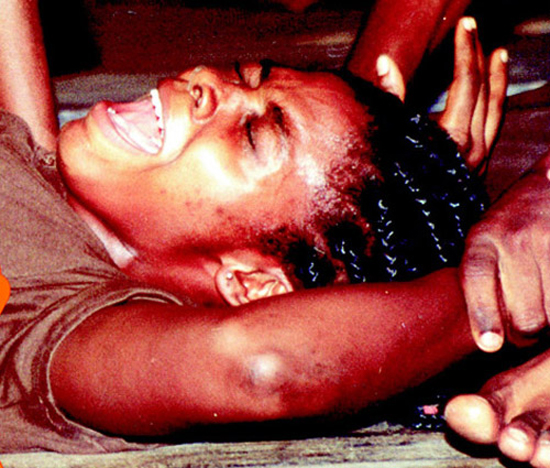
purpose of FGM is to curb the sexual desire of girls and women and
preserve their "sexual honor" before marriage. The massive
mutilation is irreversible and extremely painful,
and is usually done to young girls.
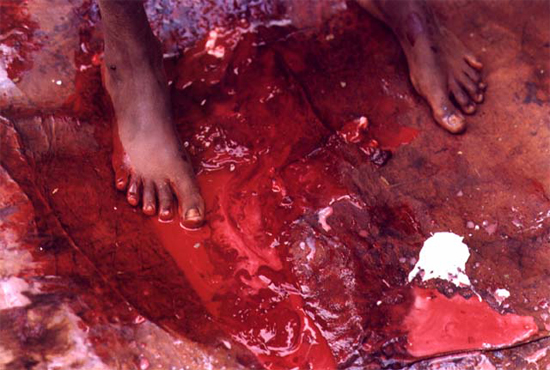 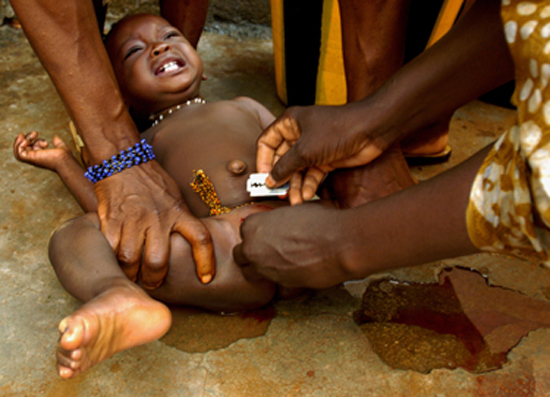 Practiced
in Egypt, Syria, Jordan, Oman, Yemen, Sudan, Somalia, Djibouti,
Mauritania, Saudi Arabia, Iraq, Iran, amongst others,
FGM is carried out with knives, scissors, scalpels, pieces of glass
or razor blades. The mutilation is usually done without anesthetics.
Instruments are usually not sterile. Mortality is high. Practiced
in Egypt, Syria, Jordan, Oman, Yemen, Sudan, Somalia, Djibouti,
Mauritania, Saudi Arabia, Iraq, Iran, amongst others,
FGM is carried out with knives, scissors, scalpels, pieces of glass
or razor blades. The mutilation is usually done without anesthetics.
Instruments are usually not sterile. Mortality is high.
The practice
has dreadful costs: many girls die afterwards, the survivors suffer
their whole life from the psychological and medical consequences
of the operation. All are traumatized and suffer from adverse health
effects during marriage and pregnancy.
 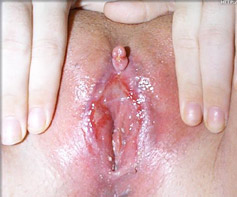
Female Genital Mutilation (FGM)
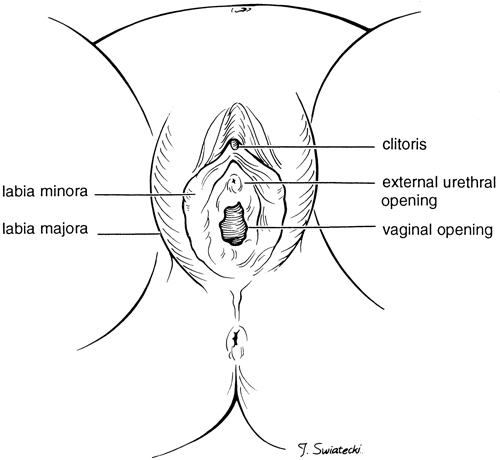
Normal female genital anatomy

(from American Academy of Pediatrics, PEDIATRICS Vol. 102 No. 1
Jul 1998, pp. 153-156)
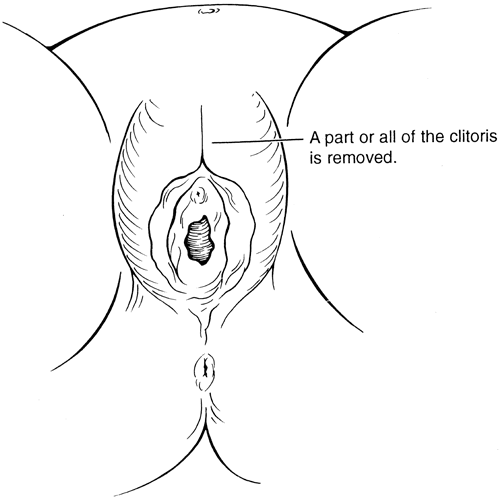
Type
I female genital mutilation,
from American
Academy of Pediatrics, PEDIATRICS Vol. 102 No. 1 Jul 1998, pp. 153-156:
"Type I FGM, often termed clitorectomy, involves excision of
the skin surrounding the clitoris with or without excision of part
or all of the clitoris (Fig 2). When this procedure is performed
in infants and young girls, a portion of or all of the clitoris
and surrounding tissues may be removed. If only the clitoral prepuce
is removed, the physical manifestation of Type I FGM may be subtle,
necessitating a careful examination of the clitoris and adjacent
structures for recognition."
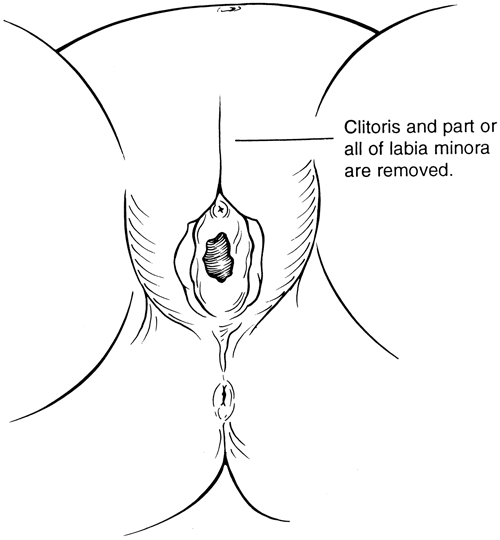
Type
II female genital mutilation,
from American
Academy of Pediatrics, PEDIATRICS Vol. 102 No. 1 Jul 1998, pp. 153-156:
"Type II
FGM, referred to as excision, is the removal of the entire clitoris
and part or all of the labia minora. Crude stitches of catgut or
thorns may be used to control bleeding from the clitoral artery
and raw tissue surfaces, or mud poultices may be applied directly
to the perineum. Patients with Type II FGM do not have the typical
contour of the anterior perineal structures resulting from the absence
of the labia minora and clitoris. The vaginal opening is not covered
in the Type II procedure."
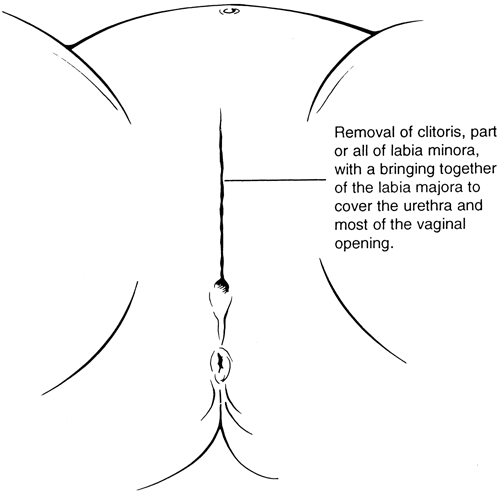
Type
III female genital mutilation,
American Academy
of Pediatrics, PEDIATRICS Vol. 102 No. 1 Jul 1998, pp. 153-156:
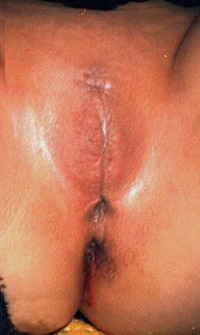
"Type III FGM, known as infibulation, is the most severe form
in which the entire clitoris and some or all of the labia minora
are excised, and incisions are made in the labia majora to create
raw surfaces. The labial raw surfaces are stitched together to cover
the urethra and vaginal introitus, leaving a small posterior opening
for urinary and menstrual flow. In Type III FGM, the patient will
have a firm band of tissue replacing the labia and obliteration
of the urethra and vaginal openings."
NO
GRAPHICS AVAILABLE
Type
IV female genital mutilation,
American Academy
of Pediatrics, PEDIATRICS Vol. 102 No. 1 Jul 1998, pp. 153-156:
"Type IV includes different practices of variable severity
including pricking, piercing or incision of the clitoris and/or
labia; stretching of the clitoris and/or labia; cauterization of
the clitoris; and scraping or introduction of corrosive substances
into the vagina.
The
physical complications associated with FGM may be acute or chronic.
Early, life-threatening risks include hemorrhage, shock secondary
to blood loss or pain, local infection and failure to heal, septicemia,
tetanus, trauma to adjacent structures, and urinary retention.13,14
Infibulation (Type III) is often associated with long-term gynecologic
or urinary tract difficulties. Common gynecologic problems involve
the development of painful subcutaneous dermoid cysts and keloid
formation along excised tissue edges. More serious complications
include pelvic infection, dysmenorrhea, hematocolpos, painful intercourse,
infertility, recurrent urinary tract infection, and urinary calculus
formation. Pelvic examination is difficult or impossible for women
who have been infibulated, and vaginal childbirth requires an episiotomy
to avoid serious vulvar lacerations.
Less
well-understood are the psychological, sexual, and social consequences
of FGM, because little research has been conducted in countries
where the practice is endemic. However, personal accounts by women
who have had a ritual genital procedure recount anxiety before the
event, terror at being seized and forcibly held during the event,
great difficulty during childbirth, and lack of sexual pleasure
during intercourse."
 Stop
female genital mutilation: appeal to the international dermatologic
community (International Journal of Dermatology 2002, 41, 253-263 Stop
female genital mutilation: appeal to the international dermatologic
community (International Journal of Dermatology 2002, 41, 253-263
Related
information:
Subjugation
of Women and Child Abuse
Genocide,
Slavery, Female Genital Mutilation (FGM)
Egypt
(member of Arab League)
Syria
(member of Arab League)
Jordan
(member of Arab League)
Oman
(member of Arab League)
Sudan
(member of Arab League)
Somalia
(member of Arab League)
Yemen
(member of Arab League)
Mauritania
(member of Arab League)
Djibouti
(member of Arab League)
Iraq
(member of Arab League)
Saudi
Arabia (member of Arab League)
Islamic
Republic of Iran
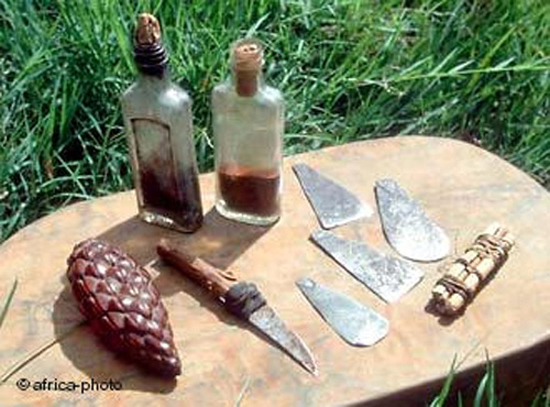
Typical
tools
for carrying out female genital mutilation (DW-World, May 4, 2004)
| Others 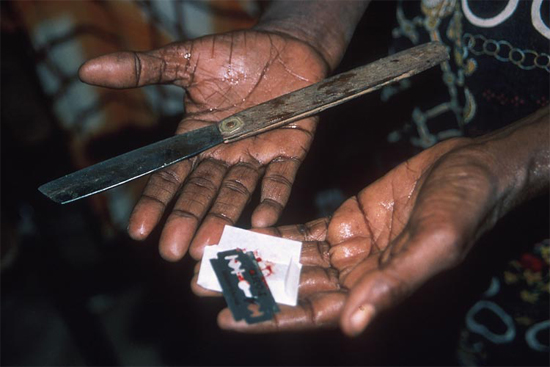
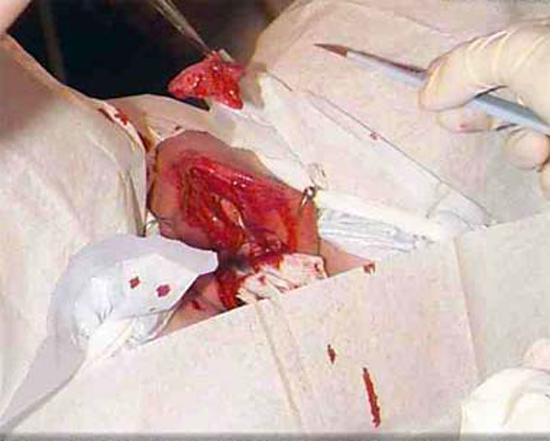
Sterile
mutilation,
performed in a hospital | Not sterile and no anesthetics
|